- Conscious: Sit up, lean forward.
- Unconscious: RSI. Avoid nasal intubation.
- Call: 2222 Major Haemorrhage.
- Prepare for Front of Neck Airway (CICO risk high).
MAX-FAX TRAUMA

Severe Max-Fax Bleed
Page 1: Walkthrough (Preparation)
🧰 HALO TROLLEY
Initial Actions and Indications Check
• Call 2222 for "Major Haemorrhage" and "Anaesthetic Emergency".
• Call ENT Registrar and Anaesthetics immediately for airway control.
• Airway: Distortion, loose teeth, blood, swelling.
• Plan A: Conscious? Sit up + Suction.
• Plan B: RSI. Anticipate difficult view. Have eFONA ready.
• Bleeding: Maxillary artery is prolific. Scalp wounds bleed heavily.
• C-Spine: Spinal motion restriction, but do NOT prioritise over airway — no collar while a conscious patient needs to lean and spit. Once intubated the collar is also part of the midface splint (see right).
Equipment
Chlorhexidine.
Suction x2 (Wide bore).
Bite Blocks / McKesson Props (x2).
Semi-rigid C-Spine Collar (sized) - mandible splint.
Option A: Nasal Epistats (Double Balloon).
Option B: TWO Foley Catheters (12-14F).
Rapid Rhino Packs (7.5cm / 9cm).
Heavy Suture (0 Silk) - Tongue Stitch.
Dressings/Packs.
TXA 1g IV. Fetch Drug
Post-Procedure Plan
• CT Head/Face.
• Transfer Theatre/Interventional Radiology.
Haemorrhage Control
- POSITION: "Lean and Spit" if conscious. Suction constantly. Sweep airway with gloved finger or Magill forceps to clear avulsed teeth and bone fragments.
- MIDFACE REDUCTION (Le Fort):
• "Dish face" appearance.
• Place gloved fingers behind upper teeth/palate.
• PULL ANTERIORLY (Hard).
• Disimpacts the maxilla. Stops bleeding.
• Hold reduction; bite blocks go in once intubated (step 4). - TONGUE STITCH: Flail mandible? Stitch tongue tip and pull forward.
- PACK + SPLINT (INTUBATED ONLY, in this order):
Option A: EPISTATS (Double Balloon)
a. Insert both sides along floor of nose — do NOT inflate yet.
b. BITE BLOCKS between molars both sides (ETT in groove).
c. Apply semi-rigid C-SPINE COLLAR — splints the mandible.
d. Inflate POSTERIOR balloons both sides together (up to 10ml) + gentle traction.
e. Inflate ANTERIOR balloons both sides together (up to 30ml).
Option B: FOLEYS + RAPID RHINO
• Insert BOTH FOLEY CATHETERS (one each side) posterior. Bite blocks + collar as b–c. Inflate posterior balloons with 10-15ml of SALINE. Pull back.
• THEN insert RAPID RHINOS Anteriorly.
Why: collar holds mandible → blocks hold palate against it → balloons fix maxilla. One-sided inflation can displace fractures.
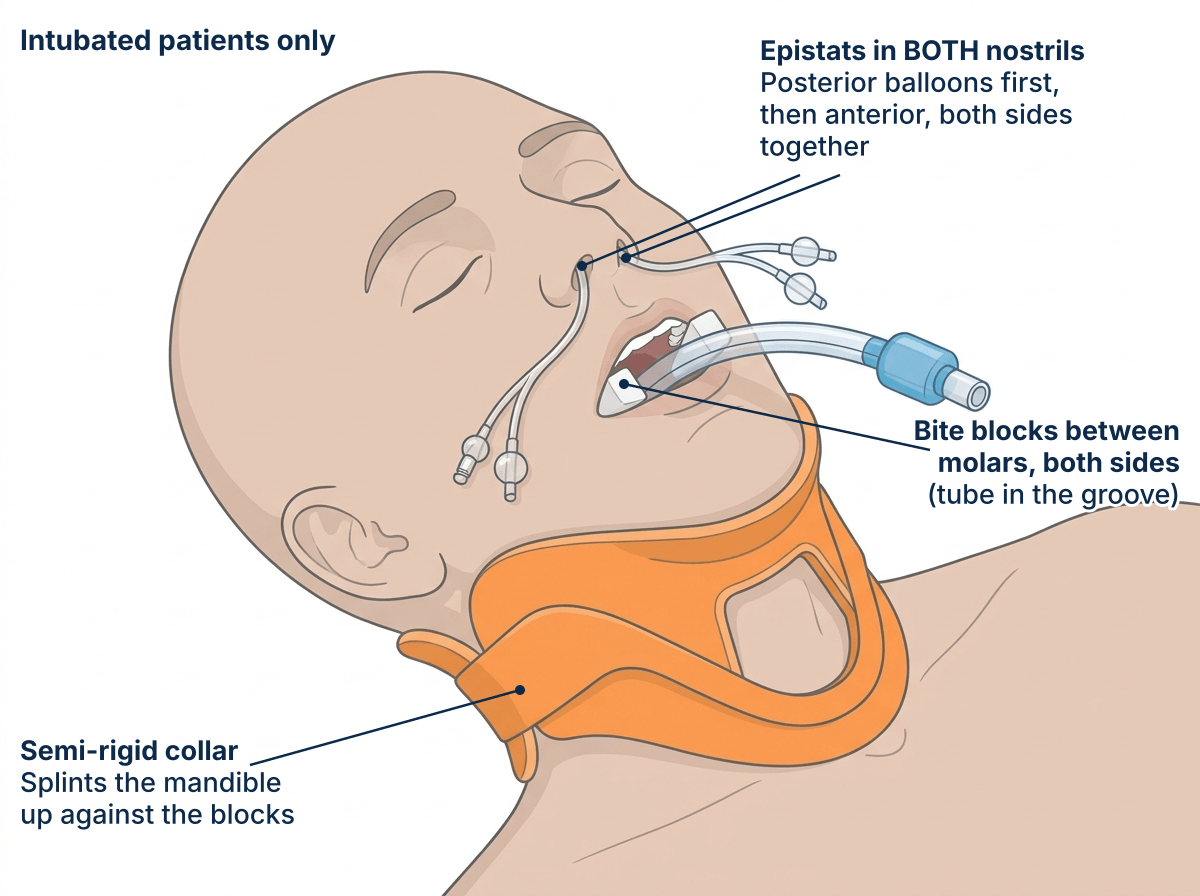
Epistats + Bite Blocks + C-Spine Collar (midface splint)
Severe Max-Fax Bleed
Page 2: Action (Stabilisation)
🧰 HALO TROLLEY
1
MIDFACE REDUCTION
- Indication: Floating Maxilla (Le Fort).
- Sweep airway with gloved finger or Magill forceps to clear avulsed teeth and bone fragments.
- Gloved fingers behind upper teeth. Pull Forward.
- Hold reduction; bite blocks go in once intubated (step 2).
2
PACK + SPLINT (INTUBATED ONLY)
- Order: Epistats in (not inflated) → Bite blocks both sides → C-Spine collar → Inflate posterior balloons both sides together (up to 10ml) + gentle traction → Inflate anterior both sides together (up to 30ml).
- Foley Method: Insert Foleys BEFORE Rapid Rhinos.
- Inflate Foley (Posterior) with 10-15ml of saline, pull back -> Then Pack Anterior. Bite blocks + collar as above.
- Conscious patient leaning forward: no collar, no supine — spinal motion restriction never takes priority over the airway.
3
ADJUNCTS & POST-PROCEDURE
- TXA 1g IV stat. Activate MHP. Transfuse early.
- Consider Tongue Suture if obstructing.
- Transfer: CT Head/Face. Theatre/Interventional Radiology.
 Reference: RCEM Learning: Floating in the Face of Danger | GNAAS Maxillofacial Trauma SOP v4 (2022) | Harris et al. Eur J Emerg Med 2010;17:230-3.
Open Guideline
MAX-FAX TRAUMA