- Ultrasound-guided if available (Safe Vascular Access 2025). Landmark technique if no US.
- Right side preferred (Lower pleural dome).
- Call: 2222 only if in active cardiac arrest.
VASCULAR ACCESS

Subclavian Line
Page 1: Walkthrough (Preparation)
🧰 HALO TROLLEY
Initial Actions and Indications Check
• Call 2222 only if in active cardiac arrest.
• Hypovolaemic Shock (Vein remains patent): use large-bore 8.5 Fr introducer for volume; triple lumen for drugs/pressors.
• C-Spine Immobilisation (IJ inaccessible).
• Contraindications: Clavicle/upper rib fracture. Coagulopathy (relative).
• Pneumothorax/chest drain on one side: go on THAT side.
• Head-down relatively contraindicated if raised ICP.
Equipment
Chlorhexidine.
Central Line Kit (Triple Lumen) and/or 8.5 Fr introducer kit.
Sterile Gown, Gloves, Drapes.
Lidocaine 1%. Fetch Drug
Saline Flushes x3. Fetch Saline
Suture (Silk) + Scalpel.
Dressings (Tegaderm).
Post-Procedure Plan
• CXR Mandatory: exclude pneumothorax.
• Tip: lower SVC / cavo-atrial junction (~4cm below carina).
• "Wire out, shout out": witness confirms, document.
• Secure well.
Landmark Technique
- POSITION: 10–20° head-down. Arms by sides, head neutral. No pillow/roll behind back (narrows clavicle–1st rib gap). Cardiac monitor on.
- LANDMARK: 1–2cm below junction of medial and middle thirds of clavicle, OR just below its midpoint.
- LOCAL: Check allergies. Infiltrate skin and periosteum with SYRINGE.
- AIM: Finger in Sternal Notch. Bevel up. Aim towards it, needle PARALLEL TO FLOOR. Walk under clavicle, aspirating constantly.
- WIRE: Flash -> rotate bevel + J-tip towards FEET. Advance 20–23cm; ectopics -> withdraw until they stop. Never let go of the wire. Resistance on withdrawal: remove needle + wire together.
- CONFIRM VENOUS before dilating: Dark, non-pulsatile blood is NOT proof in arrest/shock. USS along wire or manometry (IV tubing / transducer).
- DILATE only until it just enters the vein -> CATHETER to ~15cm (R) / 16–17cm (L).
- MAX 2–3 attempts. New equipment each time.
Subclavian Line
Page 2: Action (Infraclavicular Approach)
🧰 HALO TROLLEY
1
POSITION
- 10–20° head-down. Arms by sides. Head neutral. No roll behind back.
- If difficult: small roll under same-side shoulder, or 5cm caudal arm traction.
2
LANDMARKS
- Time-out (LocSSIP). Confirm landmarks.
- 1–2cm below medial/middle third junction (or just below midpoint). Aim: Sternal Notch.
- Keep flat: Parallel to floor (Avoids lung apex).
3
SELDINGER & POST-PROCEDURE
- Flash -> bevel + J-tip to FEET -> Wire 20–23cm (must slide easily; ectopics = pull back). Never let go of wire.
- Confirm venous before dilating (USS along wire / manometry). Dark blood is not proof in shock.
- Dilate just into vein -> Catheter ~15cm R / 16–17cm L -> Aspirate all ports -> Suture.
- "Wire out, shout out" (witnessed). Max 2–3 attempts.
- Artery: needle -> withdraw, press 10 min, watch for haemothorax. Dilator/catheter in artery -> LEAVE IN, call vascular/IR.
- Mandatory CXR: exclude pneumothorax; tip lower SVC / cavo-atrial junction.
🛑 PLAN B: FAILED ACCESS?
• Immediate Intraosseous (Humeral/Tibial) is the primary fallback for emergency access.• Femoral Line.
• Ultrasound Guided Peripheral IV (Long catheter).
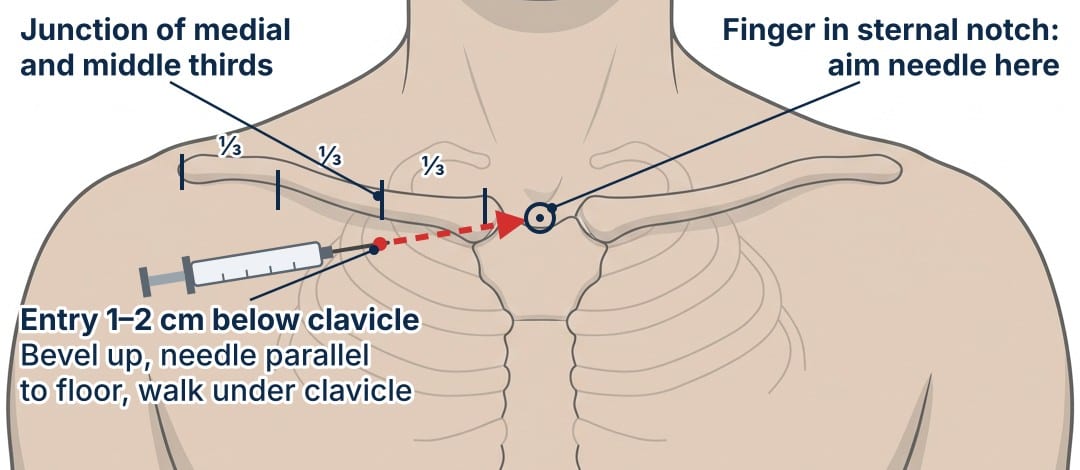
Landmark: Medial/Mid 1/3 Clavicle -> Sternal Notch
 Reference: Association of Anaesthetists Safe Vascular Access 2025; MSD Manual: Infraclavicular Subclavian Cannulation (Sep 2026).
Open Guideline
VASCULAR ACCESS