- Lat Dorsi (Posterior). Pec Major (Anterior). Axilla (Superior).
- Target: 5th ICS, just anterior to the Mid-Axillary Line.
THORACIC EMERGENCY

Chest Drain (Open)
Page 1: Walkthrough (Preparation)
🧰 HALO TROLLEY
Initial Actions and Indications Check
• Trauma: Haemothorax, Pneumothorax (ventilated/unstable).
• Medical: Empyema, Massive Effusion.
• Tension Pneumothorax: Decompress with needle/finger FIRST if arresting.
• Contraindications: Coagulopathy (Relative), Diaphragmatic Hernia.
Equipment
Chlorhexidine + Sterile Drape / Gown Pack.
Lidocaine 1% (20ml = 200mg). Fetch Drug
Max 3mg/kg plain (7mg/kg with adrenaline) — TOTAL across all procedures.
Scalpel (Size 10).
Spencer Wells Forceps (Straight).
Curved Kelly Forceps (Alternative).
Chest Tube: 28-32F (Trauma); 12-14F Seldinger kit (Air).
Silk Suture (size 0).
Underwater Seal (Primed).
Dressings (Tegaderm/Mepore).
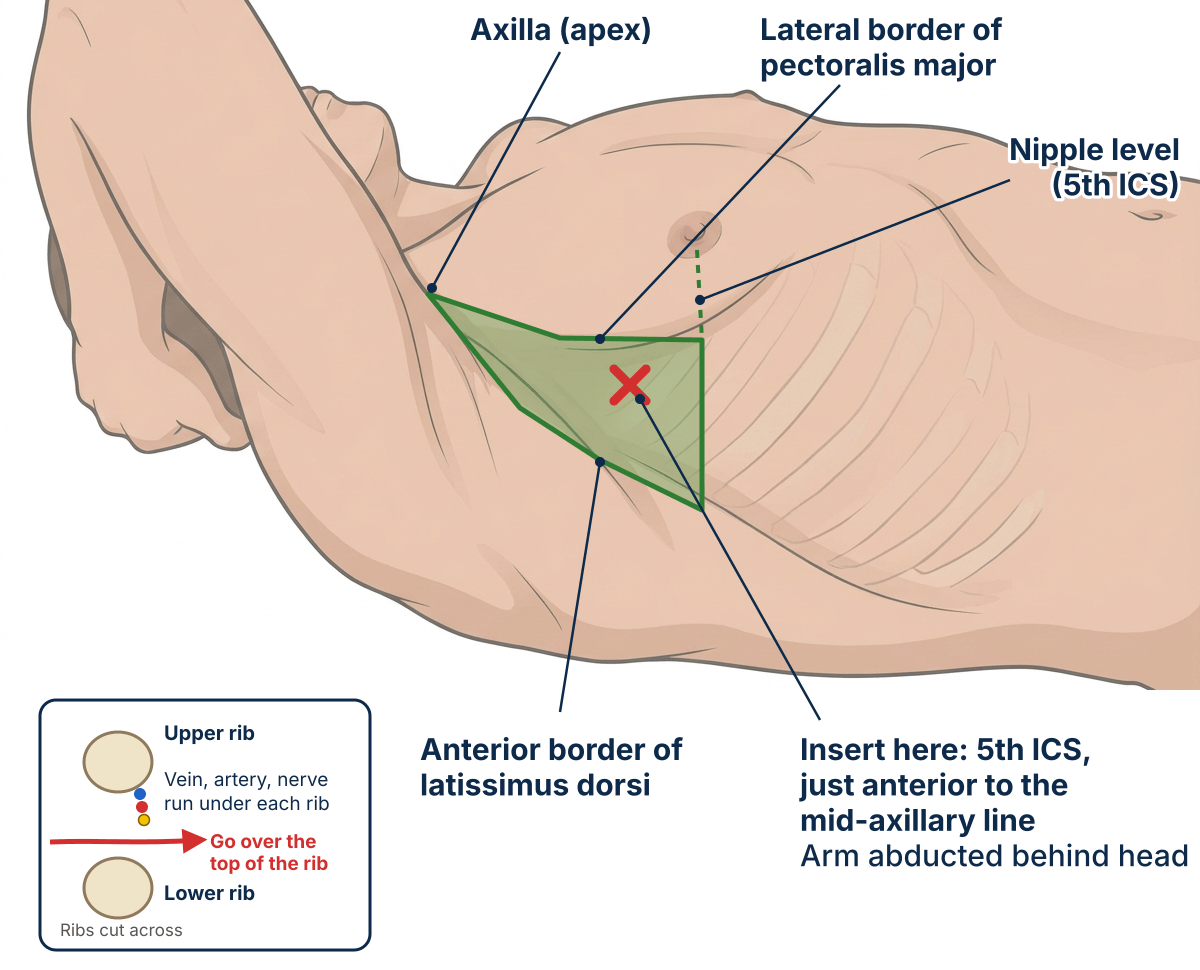
Triangle of Safety: Lat Dorsi, Pec Major, Axilla, Nipple
Open Technique
- POSITION: Supine. Arm abducted behind head. Secure arm.
- LANDMARK: Safety Triangle. 5th Intercostal Space, just anterior to the Mid-Axillary Line.
- LOCAL: Check allergies. Infiltrate skin, muscle, and pleura. Aspirate fluid/air to confirm depth.
- INCISION: 3 to 4cm Transverse cut parallel to ribs with SCALPEL.
- DISSECT: Use Straight SPENCER WELLS FORCEPS. Push closed, open to spread. Tunnel over the UPPER BORDER of the rib below (Avoid intercostal vessels).
- BREACH: Push forceps firmly through pleura ("POP"). Open jaws wide to dilate track.
- SWEEP: Insert finger. Rotate 360 degrees. Feel lung. Break adhesions. Finger Sweep mandatory. Confirm you are in chest, not abdomen.
- INSERT: Clamp CHEST TUBE tip with forceps. Guide into chest. Aim Apical (Air) or Basal (Blood). Connect seal. Secure with SILK SUTURE.
Post-Procedure Plan
• Connect to underwater seal.
• Secure with sutures/dressings.
• Check Position: Request CXR to confirm placement.
• Monitor Output: Massive output (> 1500ml stat or > 200ml/hr for 2–4 hrs) requires immediate cardiothoracic involvement.
Chest Drain (Open)
Page 2: Action (Trauma / Haemothorax)
🧰 HALO TROLLEY
1
SAFETY TRIANGLE
2
DISSECTION
- Pause for 5 seconds. Confirm landmarks.
- Check allergies. Give LA (max 3mg/kg plain, 7mg/kg with adrenaline — total dose). 3cm Transverse incision.
- Blunt dissection with Spencer Wells Forceps.
- Stay on Upper Border of Lower Rib (avoid vessels).
3
PLEURAL ENTRY
- Breach pleura with forceps ("Pop"). Dilate track.
- Finger Sweep mandatory (Verify cavity).
- Insert Tube. Look for fogging/swinging.
🛑 PLAN B: CANNOT INSERT?
• Enlarge incision. Insert Finger again.• Use Bougie to guide tube.
• Decompress with Finger Thoracostomy if arresting.
4
SECURING & POST-PROCEDURE
- Connect to underwater seal.
- Suture: Mattress or Stay suture (size 0 Silk). Tape securely.
- Post-Procedure: Request CXR to confirm position. Monitor drain output. Massive output (> 1500ml stat or > 200ml/hr for 2–4 hrs) requires immediate cardiothoracic involvement and possible thoracotomy.
 Reference: RCEM Learning - Chest Drain Insertion in Adult Trauma | BTS Pleural Disease Guideline (2023).
Open Guideline
THORACIC EMERGENCY