- Call: 2222 Trauma / Medical Emergency.
- Discuss with burns (QE) before cutting unless ventilation is failing now.
- Chest: Ventilatory compromise. Limbs: Absent Doppler / distal SpO₂ <95%.
- Analgesia/sedation — surrounding partial-thickness burns are painful.
BURNS EMERGENCY
Escharotomy
Page 1: Walkthrough (Preparation)
🧰 HALO TROLLEY
Initial Actions and Indications Check
• 2222 trauma team. Discuss with burns service (QE) BEFORE cutting, unless ventilation is failing now (LSEBN).
• Circumferential full thickness / deep dermal burns (painless, leathery, white/charred).
• Chest/neck/torso: Ventilation difficulty. High peak pressures (> 30). Hypoxia.
• Limbs: Absent Doppler flow or distal SpO₂ <95% (without systemic hypotension/hypoxia). Loss of pulses is late. Skin temperature is unreliable.
Equipment
Chlorhexidine.
Sterile Drape / Gown Pack.
Scalpel (Size 22).
Sterile Skin Marker (Draw lines first).
Artery Forceps + Gauze (pressure).
Lidocaine 1%, 10ml syringe, 25G + 21G needles. Fetch Drug
Cling Film + Loose Bandages (Crepe).
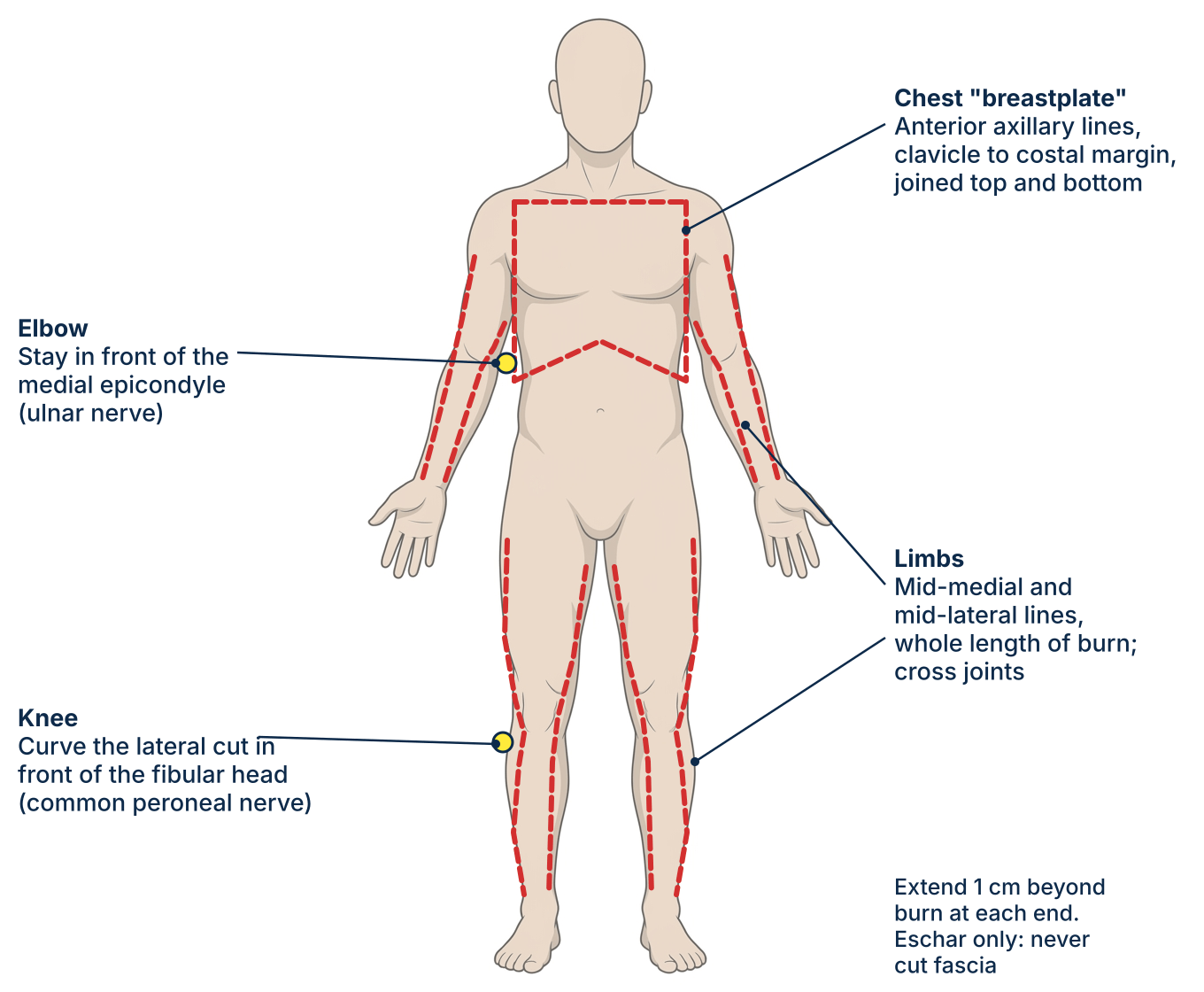
Mark lines before cutting
Incision Technique
- MARK: Draw lines with MARKER. Extend 1cm beyond burn at each end; cross joints.
- ANALGESIA: Full thickness is painless; LA/opioid for deep partial-thickness edges.
- DEPTH: Cut through eschar down to subcutaneous fat with SCALPEL. STOP: Never cut fascia or muscle.
- RELEASE: Edges must gape widely; run finger along cut. Bleeding should be minimal at the right depth: press; artery forceps for a discrete vessel. Brisk bleeding = too deep.
- CHEST ("Breastplate"): Anterior axillary lines, clavicle to costal margin (avoid breast tissue); join across top and bottom (subcostal chevron).
- NECK: Lateral and posterior (avoid carotid/jugular).
- UPPER LIMB: Mid-lateral + mid-medial. Elbow: ANTERIOR to medial epicondyle (ulnar nerve). Wrist: avoid radial nerve. Hand: dorsal over metacarpals; extend to thenar/hypothenar.
- LOWER LIMB: Mid-lateral + mid-medial. Knee: curve lateral cut around fibular neck (common peroneal). Ankle: avoid posterior tibial vessels (medial). Foot: to great toe medially, little toe laterally.
Post-Procedure Plan
• Reassess: Doppler / distal SpO₂. Not improved → recheck depth; never cut fascia.
• Cover: loose longitudinal cling film strips or dressing agreed with burns. Loose bandage.
• Elevate limbs. Keep warm.
• Transfer: Specialist Burns Centre / ICU.
Escharotomy
Page 2: Action (Burns Release)
🧰 HALO TROLLEY
1
CHEST ("BREASTPLATE")
- Pause for 5 seconds. Confirm landmarks.
- Vertical: Bilateral anterior axillary lines, clavicle to costal margin. Avoid breast tissue.
- Transverse: Connect tops (clavicle) and bottoms (costal margin / subcostal chevron).
- Result: Chest wall must spring open. Neck: lateral + posterior cuts.
2
UPPER LIMBS
- Lines: Mid-Lateral and Mid-Medial, 1cm beyond burn, across joints.
- Hand: Dorsal over metacarpals; extend to thenar/hypothenar.
- Ulnar Nerve: Cut ANTERIOR to Medial Epicondyle. Wrist: avoid radial nerve.
3
LOWER LIMBS
- Lines: Mid-Lateral and Mid-Medial.
- Foot: to great toe medially, little toe laterally.
- Peroneal Nerve: Curve around the fibular neck. Ankle: avoid posterior tibial vessels.
4
POST-PROCEDURE
- Reassess Doppler / distal SpO₂. Not improved → recheck depth; do NOT cut fascia — discuss fasciotomy with burns/plastics.
- Bleeding should be minimal: press; clamp a discrete vessel. Brisk bleeding = too deep.
- Cover: loose longitudinal cling film strips (or burns-agreed dressing). Loose bandage.
- Elevate limbs. Keep warm.
- Transfer: Specialist Burns Centre / ICU.
 Reference: LSEBN Initial Management of Severe Burns (2026) | MSD Manual: Burn Escharotomy (2025).
Open Guideline
BURNS EMERGENCY