- ≤15 min from loss of vital signs (ERC 2025); blunt <10 min. 2222 + MHP.
TRAUMA ARREST
Resuscitative Thoracotomy
Page 1: Walkthrough (Preparation)
🧰 HALO TROLLEY
Initial Actions and Indications Check
• Call 2222 "Trauma Cardiac Arrest". Activate Major Haemorrhage Protocol. O-negative blood.
• Consider WMAS MERIT / HEMS: patient will need transfer to QE.
• ERC 2025: ≤15 min from loss of vital signs.
• Penetrating: Arrest <15 min. Blunt: <10 min (highly selective).
• Signs of Life: Pupils reacting, gasping, ECG activity, cardiac motion on US.
• Best results before output is fully lost. Tamponade can survive ~15 min; exsanguination rarely >5 min.
Team & Set-up
• Minimum 2: OPERATOR (surgical field only) + ASSISTANT (ventilation timing, instruments, sharps + swab count, scene).
• Arms out (crucifix) before cutting: arm by side shortens incision + hampers aortic compression.
• Ventilation: SGA is fine. PAUSE for pleural entry, pericardium, heart inspection, hilar control. Resume small tidal volumes once massage/output.
• Gown/gloves for sharps risk (saw, shears, rib edges). Good lighting.
Equipment Tray
Chlorhexidine, sterile drapes/gowns, sterile skin marker.
Scalpel size 22 + curved scissors.
Tuff Cut shears + Gigli saw (handles + wire).
Finochietto retractor (check assembled correctly).
Toothed forceps (Bonney's), artery forceps (Spencer Wells).
Non-crushing vascular clamps (Satinsky/DeBakey).
2-0 Prolene/silk on curved non-cutting needle, skin stapler.
Counted swabs, NG tube, internal paddles.
Foley 20F (last resort), large dressings, cling film.
Clamshell Technique
- MARK: Just below nipple line (5th ICS). Breast tissue: lift breast, use inframammary fold.
- SKIN: One arc, skin + subcut, towards POSTERIOR axillary line both sides (spare latissimus dorsi). Join thoracostomies if correctly sited.
- PLEURA: CURVED SCISSORS along upper border of rib. Never enter pleura with scalpel. Different ICS each side? Extend one across sternum to match.
- STERNUM: TUFF CUT SHEARS first. Gigli saw: assistant holds Spencer Wells flat across sternum to stop saw springing up.
- OPEN: FINOCHIETTO, handle down, crank open. Release sterno-pericardial ligament.
- PERICARDIUM: Lift with forceps, nick centre, ONE continuous vertical cut head-to-toe, ANTERIOR to phrenic nerve. Evacuate clot.
- DELIVER HEART: Inspect all surfaces for wounds.
- THEN: Cardiac wounds → lung → aorta → massage (see page 2).
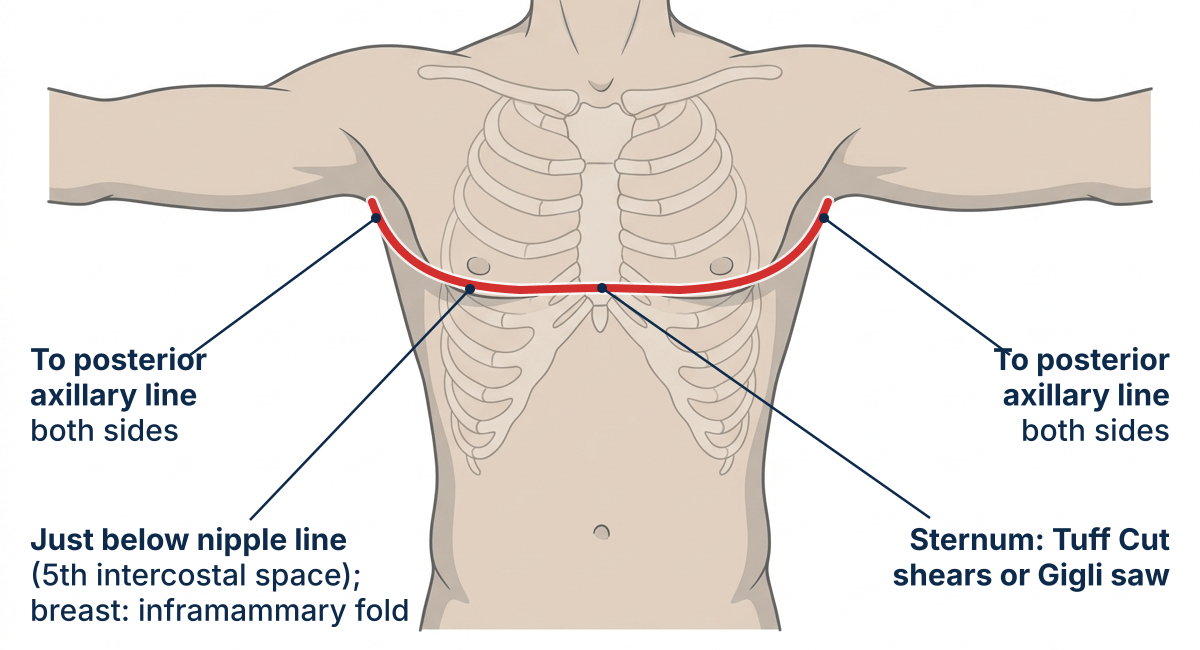
Clamshell: towards posterior axillary line, both sides
📍 STORAGE LOCATION
THORACOTOMY KIT (FINOCHIETTO RETRACTOR, GIGLI SAW) AND INTERNAL PADDLES ARE IN THE THORACOTOMY DRAWER OF THE HALO TROLLEY.
Resuscitative Thoracotomy
Page 2: Action ("The Clamshell")
🧰 HALO TROLLEY
1
OPEN THE CHEST (PAUSE VENTILATION)
- Scalpel skin → scissors intercostals (upper rib border) → Tuff Cut sternum → Finochietto.
- Pericardium: one vertical cut, anterior to phrenic nerve. Evacuate clot. Deliver heart.
2
THEN, IN ORDER (FIX BLEEDING AS FOUND)
- Heart wound: finger / direct pressure first. Suture: curved non-cutting needle, mattress suture. Don't overtighten (cuts through as heart fills). Foley = last resort (enlarges defect).
- ⚠️ DO NOT OCCLUDE CORONARY ARTERIES. Near one: suture DEEP to it, or hold pressure.
- Lung bleeding: counted swabs → non-crushing clamp → hilar control. Lung twist = last resort.
- Aorta: release inferior pulmonary ligament. Palm up to spine: first tube = aorta, then oesophagus (NG helps). Compress with palm/fist against spine, near diaphragm. No pinching. Clamp only if trained.
- Internal massage: flat hands, both palms, no fingertips. 80–100/min, allow filling. Empty heart = give volume. Sole job; rotate early.
3
VF: FIX FLOW FIRST, THEN SHOCK
- Traumatic VF = poor coronary flow: fix bleeding, aorta, volume, massage first.
- Internal paddles: 10–20 J, up to 40 J if first shock fails.
- No paddles: partly close chest. Pads anteroposterior; anterior pad must NOT cross incision. 200J. No one touching.
4
ROSC
- Clamp bleeding internal mammary arteries. Partly close; leave retractor in, loosened, for re-entry.
- Keep warm (cling film, blankets). Sedate + paralyse. Theatre with cardiothoracics.
- Ongoing aortic compression: 45 s on / 15 s off. Isolated tamponade: avoid over-resuscitation.
🛑 STOP CRITERIA
Injuries incompatible with life, or no ROSC despite tamponade release, adequate volume + aortic occlusion (ETCO₂ and cardiac filling help decide).
Survival ~2% in exsanguination; none if tamponade + exsanguination coexist. Beware bias to continue. Consensus decision. Debrief the team.
Injuries incompatible with life, or no ROSC despite tamponade release, adequate volume + aortic occlusion (ETCO₂ and cardiac filling help decide).
Survival ~2% in exsanguination; none if tamponade + exsanguination coexist. Beware bias to continue. Consensus decision. Debrief the team.
 Reference: Chesters A et al. Emergency thoracotomy: how to do it in 2026. Emerg Med J 2026 (doi:10.1136/emermed-2026-216110) | South East Scotland Major Trauma Guidelines - Resuscitative Thoracotomy | FPHC Traumatic Cardiac Arrest Position Statement (2024).
Open Guideline
TRAUMA ARREST